
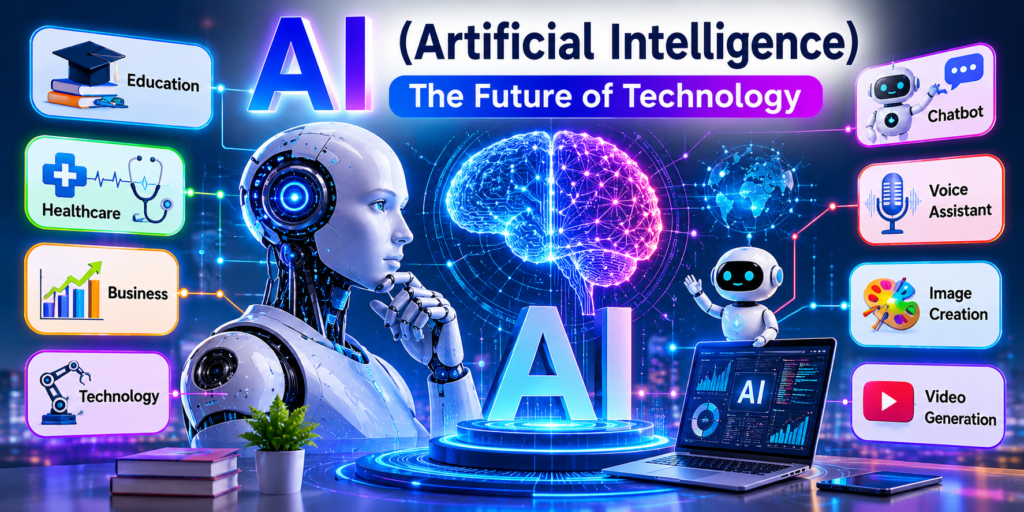
What Is AI (Artificial Intelligence)?
AI (Artificial Intelligence) is a technology that enables computers and machines to perform tasks that normally require human intelligence, such as thinking, learning, analyzing information, and making decisions.
Simply put, AI is the technology that makes computers “smart.”
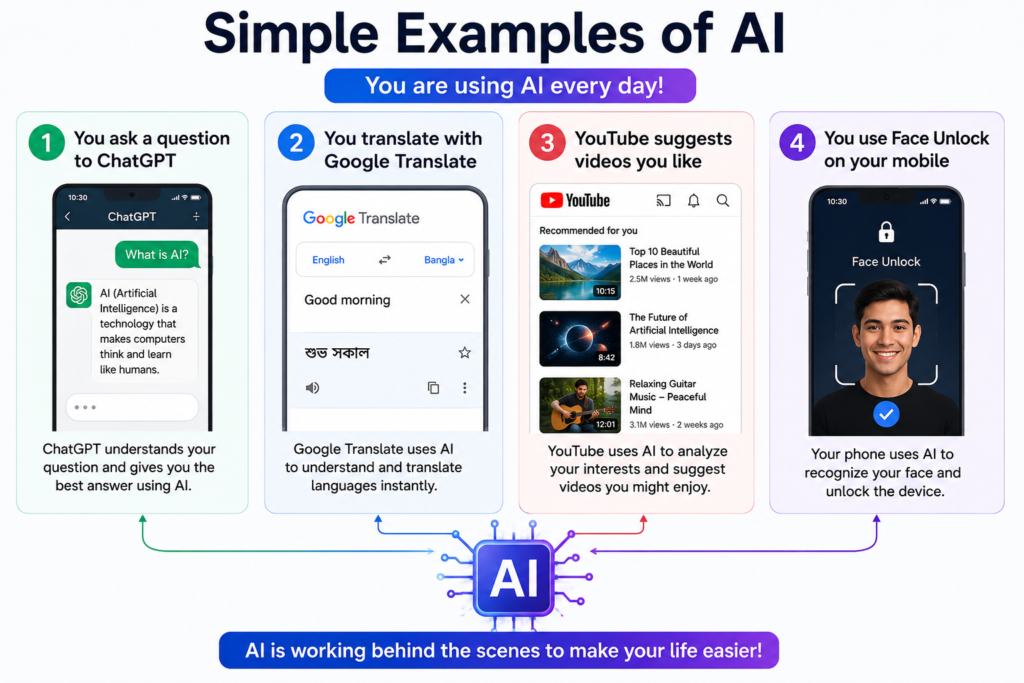
Simple Examples of AI
Artificial Intelligence (AI) is used in many everyday applications. Here are some simple examples of AI that we use regularly:
1. Voice Assistants
Voice assistants like Siri, Google Assistant, and Alexa use AI to understand voice commands and provide answers or perform tasks.
2. Chatbots
Many websites use AI-powered chatbots to answer customer questions and provide support 24/7.
3. Recommendation Systems
Platforms like YouTube, Netflix, and Spotify use AI to recommend videos, movies, and music based on user preferences.
4. Email Spam Filters
AI helps identify unwanted emails and automatically moves them to the spam folder.
5. Face Recognition
Smartphones use AI-based face recognition technology to unlock devices securely.
6. Navigation Apps
Apps such as Google Maps use AI to analyze traffic conditions and suggest the fastest routes.
7. Online Shopping Suggestions
E-commerce websites use AI to recommend products based on browsing and purchasing history.
8. Language Translation
Tools like Google Translate use AI to translate text and speech between different languages.
Conclusion
AI has become a part of our daily lives. From voice assistants to navigation apps, AI helps make tasks easier, faster, and more convenient.
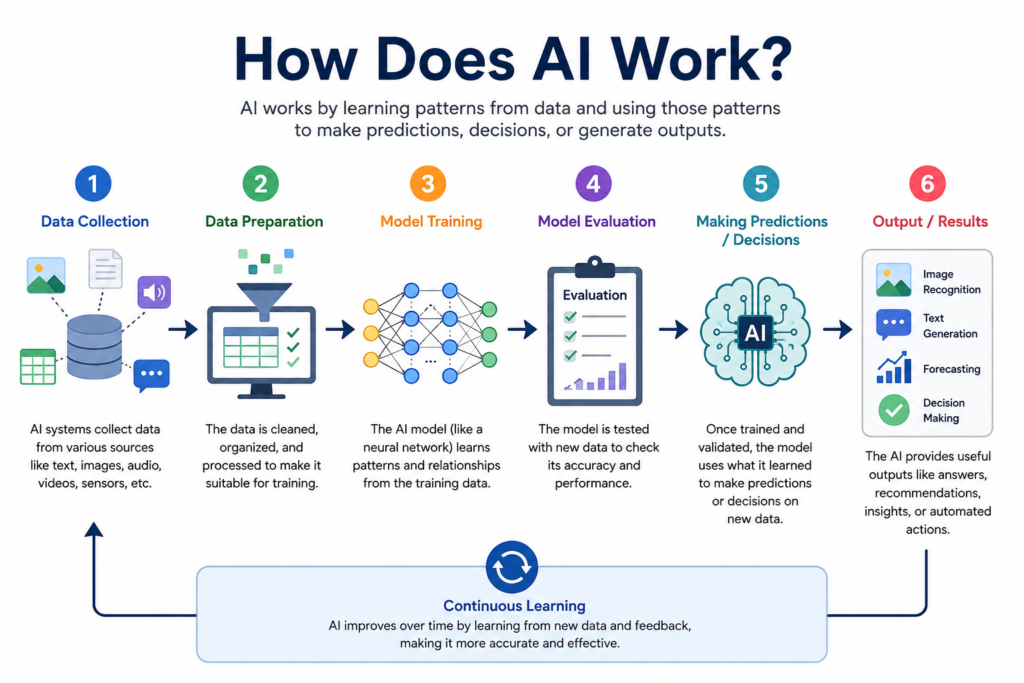
How Does AI Work?
Artificial Intelligence (AI) works by learning from data and identifying patterns to make decisions, predictions, or perform tasks automatically. AI systems follow a series of steps to process information and generate useful results.
1. Data Collection
AI collects data from various sources such as text, images, videos, audio, sensors, and databases. High-quality data is essential for effective AI performance.
2. Data Preparation
The collected data is cleaned, organized, and formatted to make it suitable for training AI models. This step removes errors and irrelevant information.
3. Model Training
AI models learn from the prepared data by identifying patterns and relationships. During training, the system adjusts its parameters to improve accuracy.
4. Model Evaluation
After training, the AI model is tested using new data to evaluate its performance and ensure it produces accurate results.
5. Making Predictions and Decisions
Once trained, the AI system can analyze new information and make predictions, recommendations, or decisions based on what it has learned.
6. Output Generation
AI provides outputs such as answers, recommendations, image recognition, language translation, or automated actions.
7. Continuous Learning
Many AI systems improve over time by learning from new data, user feedback, and updated information.
Conclusion
AI works by collecting data, learning patterns, making predictions, and continuously improving its performance. This process enables AI to solve problems and assist people in various fields.
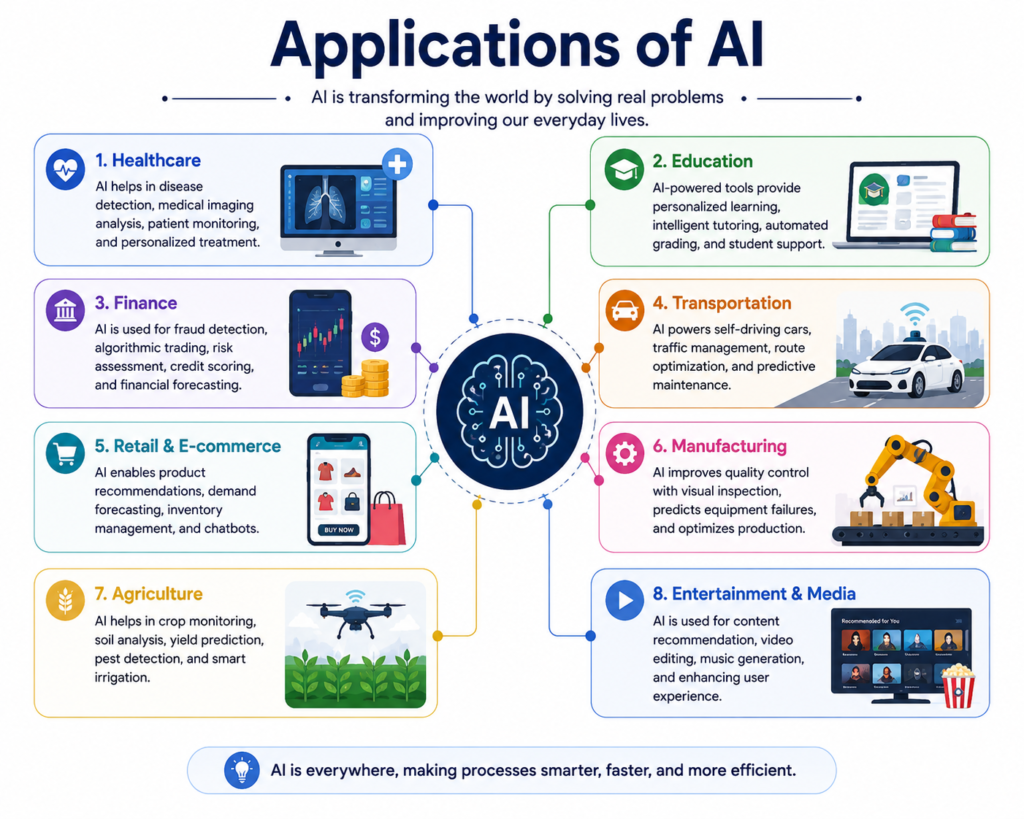
Applications of AI
Artificial Intelligence (AI) is widely used in various industries and aspects of daily life. It helps improve efficiency, accuracy, and decision-making. Some important applications of AI are:
1. Healthcare
AI is used in disease diagnosis, medical imaging, patient monitoring, drug discovery, and personalized treatment plans.
2. Education
AI-powered tools support personalized learning, intelligent tutoring systems, automated grading, and student performance analysis.
3. Finance
AI helps detect fraud, assess risks, automate trading, analyze financial data, and improve customer service in banking.
4. Transportation
AI is used in self-driving vehicles, traffic management systems, route optimization, and predictive maintenance.
5. Retail and E-Commerce
Online stores use AI to recommend products, manage inventory, predict customer behavior, and improve shopping experiences.
6. Manufacturing
AI improves production processes through quality control, predictive maintenance, robotics, and automation.
7. Agriculture
AI assists farmers in crop monitoring, soil analysis, pest detection, smart irrigation, and yield prediction.
8. Entertainment and Media
AI is used for content recommendations, video editing, music generation, gaming, and personalized user experiences.
Conclusion
AI has become an essential technology in modern society. Its applications continue to grow across different sectors, making processes smarter, faster, and more efficient.
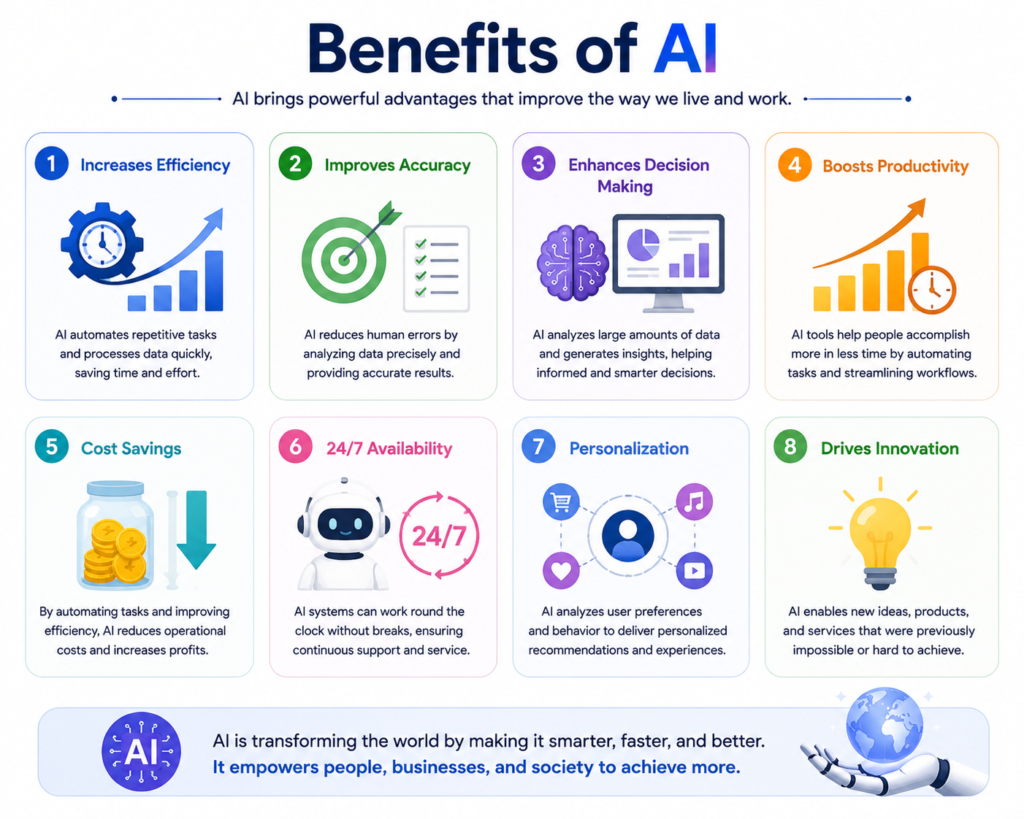
Benefits of AI
Artificial Intelligence (AI) provides numerous benefits that improve our daily lives, businesses, and industries. Some of the major benefits of AI are:
1. Increases Efficiency
AI automates repetitive tasks and processes data quickly, saving both time and effort. This allows people to focus on more important and creative work.
2. Improves Accuracy
AI systems can analyze large amounts of data with high precision, reducing human errors and providing more accurate results.
3. Enhances Decision Making
AI helps organizations make better decisions by analyzing data, identifying patterns, and generating useful insights.
4. Boosts Productivity
By automating routine tasks, AI enables individuals and businesses to complete more work in less time and improve overall productivity.
5. Cost Savings
AI reduces operational costs by increasing efficiency, minimizing errors, and optimizing resource utilization.
6. 24/7 Availability
Unlike humans, AI systems can operate continuously without breaks, providing round-the-clock support and services.
7. Personalization
AI analyzes user preferences and behavior to deliver personalized recommendations, products, and services.
8. Drives Innovation
AI encourages innovation by enabling the development of new technologies, products, and solutions that were previously difficult to achieve.
Conclusion
AI is transforming the world by making processes smarter, faster, and more efficient. It empowers individuals, businesses, and society to achieve greater success and innovation.
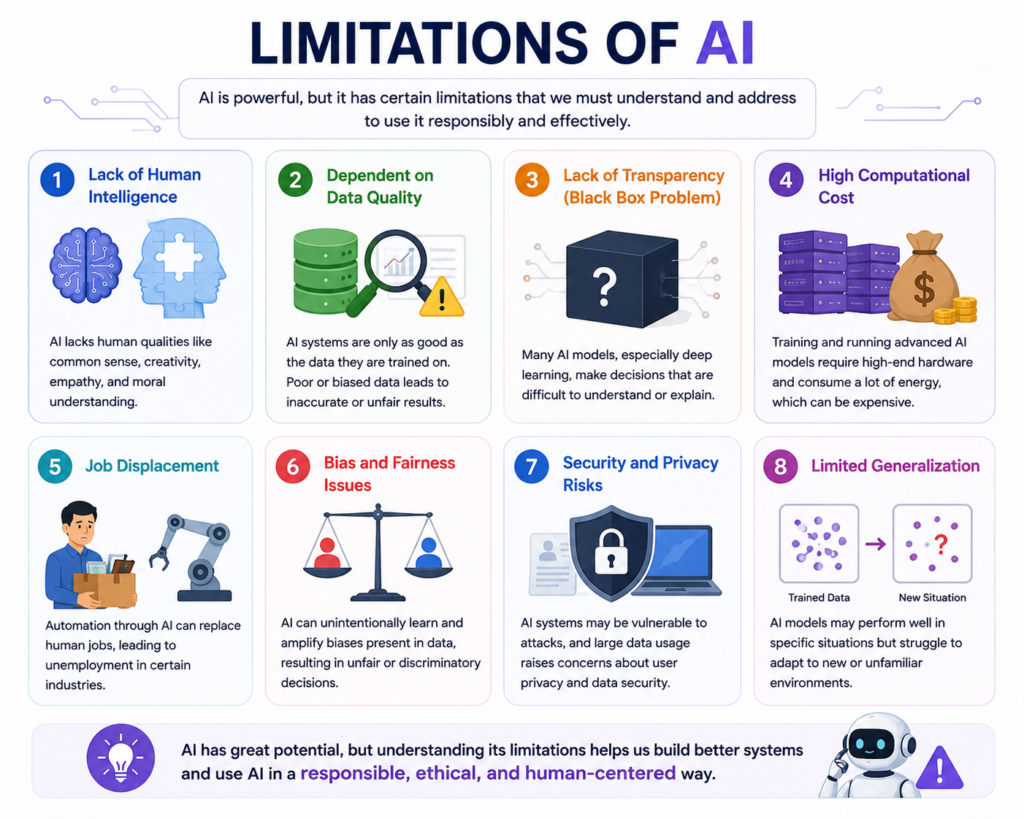
Limitations of AI
Artificial Intelligence (AI) has many advantages, but it also has several limitations. Understanding these limitations is important for using AI responsibly and effectively.
1. Lack of Human Intelligence
AI cannot fully replicate human intelligence. It lacks common sense, emotions, creativity, empathy, and moral judgment.
2. Dependent on Data Quality
AI systems rely heavily on data. If the training data is incomplete, biased, or inaccurate, the AI may produce incorrect or unfair results.
3. Lack of Transparency (Black Box Problem)
Many AI models make decisions in ways that are difficult for humans to understand or explain, creating transparency issues.
4. High Computational Cost
Developing and running advanced AI systems requires powerful hardware, large amounts of data, and significant energy consumption, making it expensive.
5. Job Displacement
Automation through AI can replace certain human jobs, especially repetitive and routine tasks, leading to unemployment in some sectors.
6. Bias and Fairness Issues
AI can inherit and amplify biases present in training data, which may result in unfair or discriminatory outcomes.
7. Security and Privacy Risks
AI systems often process large amounts of personal data, raising concerns about privacy, data protection, and cybersecurity threats.
8. Limited Generalization
AI performs well in specific tasks but may struggle when faced with unfamiliar situations or tasks outside its training scope.
Conclusion
Although AI has great potential, it is not perfect. Understanding its limitations helps us develop better AI systems and use them in a responsible, ethical, and human-centered manner.